Smart People Have Important & Critical Things to Say About A.I.
I have been taking notes for weeks with the intent to write a post about A.I. and why, from a sustainability point-of-view, we should be wary and skeptical of it.
But, then I thought, why would I write this post? I’m not an expert on it, and, more importantly, why would any of you read such a post and let it influence your opinion? Besides, I have cookies to bake before my son heads back to North Carolina.
This morning, I decided it was still an issue I wanted to include in my portfolio of blog topics because it does have implications for sustainability. My intent in starting this blog and my small business was to put my own ideas about suburban sustainability into action, and to make the case to people in my community that they could make changes in their own lives that leave future generations in a not-so-dire place.
I’m rationalizing one post about AI because part of the sustainability ethos, as I see it, is understanding that resources are finite and it matters how we use them. It is good for us all to be clear what an appropriate use of resources is, which includes land, water, electricity, etc. It’s also good for us to have a clear idea about the kind of future we want. I, for one, am not willing to cede the terrain to the tech billionaires. They’ve never had our wellbeing in mind when they roll out their products and they never will.
So, in lieu of me writing a post that I’m unqualified to write, I’m going to point you towards smart people who you should listen to.
A.I. Is Fueling a ‘Poverty of Imagination.’ Here’s How We Can Fix It. | 'The Opinions' podcast
If you’ve got a short attention span on this topic, I recommend this 30-minute conversation between Tressie McMillan Cottom, Jessica Grose and Mehar Ahmad. It’s a conversation that is mostly about use of A.I. in the classroom, but it also serves as a primer for what A.I. is and how it cheats us.
Dr. Cottom says early in in this discussion that AI is the “averaging of the mid-level ranges of responses to a prompt.” That’s as good a description as any of what A. I. actually is, and it lifts the veil that the tech companies have draped the conversation in.
Here are the two columns by Tressie and Jessica that inform the conversation:
Actually, A.I. is Pretty Mid. Tressie McMillan Cottom.
Efficiency is Leading Us Nowhere. Jessica Grose
The A.I. Job Crisis Arrives
In our local Nextdoor conversations, there’s one guy who keeps calling people Luddites if they are critical of A.I. or protest the use of local resources to build and run data centers. He thinks it’s a clever insult, I guess, but doesn’t realize that Luddites were people who protested certain technologies because of their concern over child labor and destruction of livelihood.
Author Brian Merchant has written a book titled “Blood in the Machine,” (and writes a substack with the same name) that examines the parallels of the Luddite movement with the efforts of today’s tech companies to replace jobs with A.I.
Here’s a short conversation with Merchant on The Majority Report to learn more about his views on A.I. and its intersections with employment.
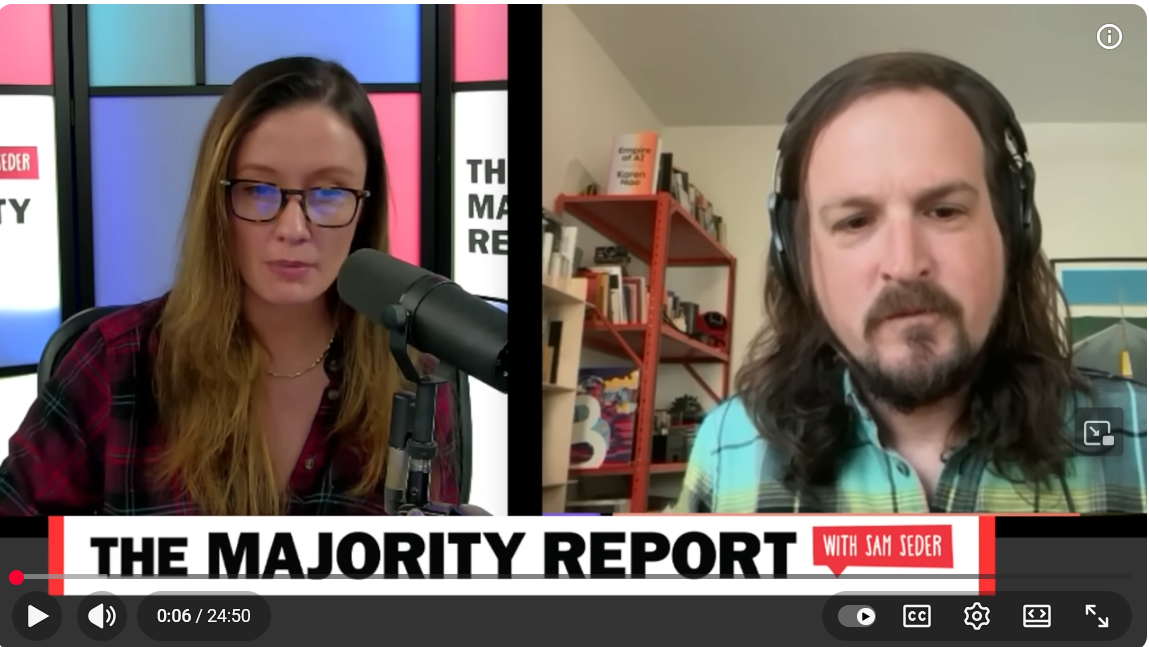
Writer Brian Merchant discusses his reporting on AI and it’s encroachment on human jobs on his blog Blood in the Machine.
Choose Your Own Adventure, More Links
I said I was writing this post as a time saver, but I’m already putting more time in than I wanted to. I want to start baking, so I’ll leave you with some additional links that I hope will be helpful.
On the Media, Deep Fakes, Data Centers, and AI Slop — Are We Cooked?
Bridge Magazine, Environment Watch: Bridge Magazine does great reporting on all kinds of environmental issues in Michigan. Look through this list and you’ll find some articles on data centers and A.I.
74 suicide warnings and 243 mentions of hanging: What ChatGPT said to a suicidal teen (this is not the only story about how AI has encouraged suicide and fosters mental health crises in young people. There are more and it is reason enough for me to say, “No.”)
Sneaking another Tressie McMillan Cottom perspective in here (article by Joe Wilkins): Professor Warns That the Wealthy Are Trying to Use AI to Seize Control of Everything. "This promise of an AI future, is really just a collective anxiety that wealthy people have about how well they're gonna be able to control us in the future."